
Bronze on Debut: Zhang’s 12-Attempt Podium
On her first World Cup final, Yuetong Zhang reached the podium on the joint-fewest attempts in the field, and 7:13 on the wall.

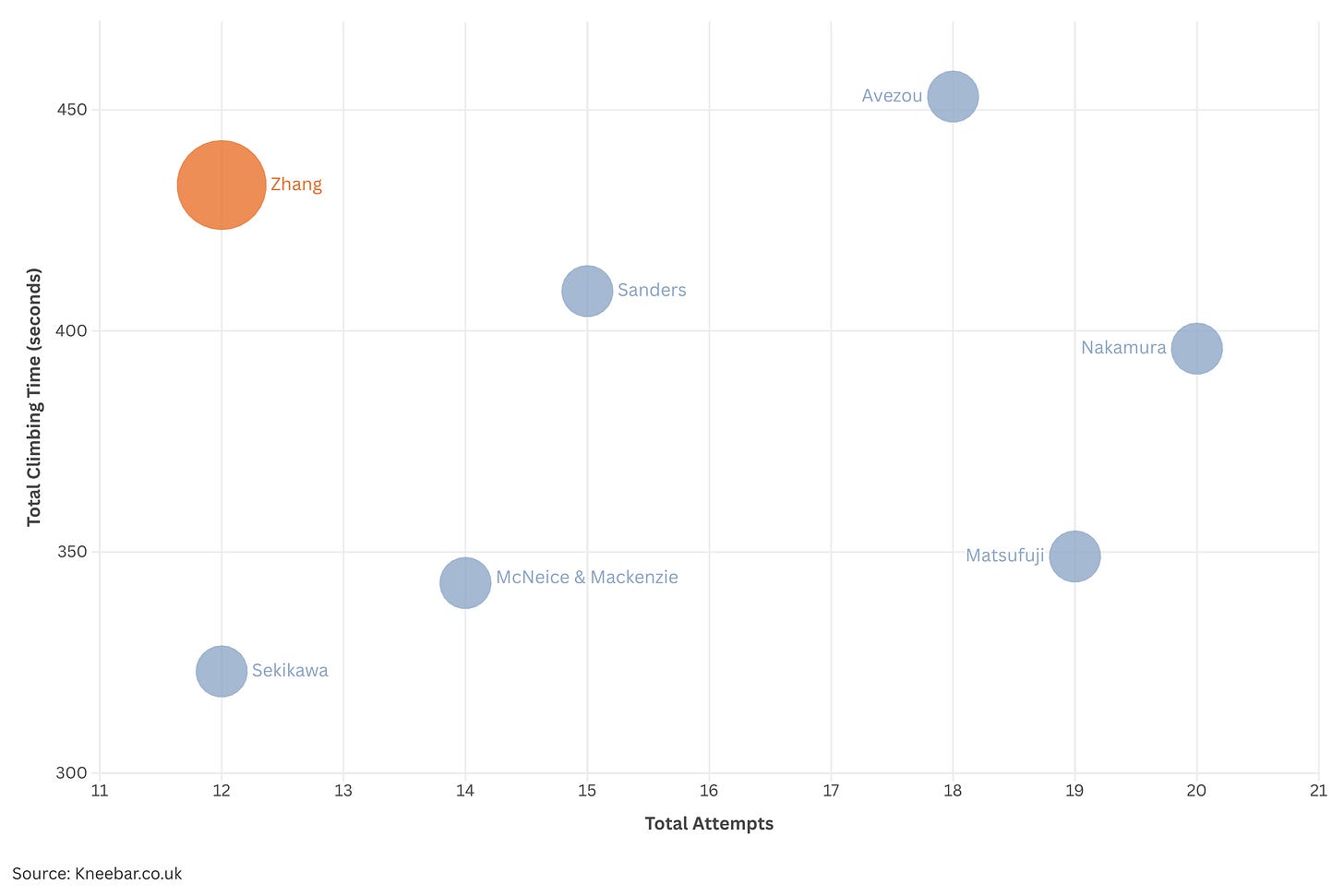
Yuetong Zhang took bronze on her first World Cup boulder final from 12 attempts, the joint-fewest of any finalist at Prague 2026, and among the top three for time on the wall on every problem, Kneebar data shows.
The read: Zhang is the seventh woman since 2022 to podium on a debut final, and among the least experienced climbers in the Prague final. What set her apart was not only how high she climbed but also how she went about it: climbing fewer times and for longer, showing a consistency no other finalist matched.
Finalists: Melody Sekikawa, Annie Sanders, Yuetong Zhang, Anon Matsufuji, Oceana Mackenzie, Mao Nakamura, Zélia Avezou, Erin McNeice.
The numbers:
12 attempts, joint-fewest in the final with Sekikawa, for two tops and bronze
7:13 on the wall in total, second-longest in the final behind Avezou, who took six more attempts to get there and finished seventh
Sekikawa made the same 12 attempts but spent the least time on the wall of any finalist, 5:23, and finished fourth
Three attempts across the two boulders Zhang topped: W4 flashed, W3 topped on her second go
One of only three climbers to top W4, all three by flashing it; nobody who missed the flash recovered it
In the top three for time on the wall per attempt on all four boulders (2nd, 1st, 3rd and 2nd of eight), the only finalist to manage it on every one
Boulder by boulder:
W1, the boulder only Sanders topped. Every other finalist reached the zone, progressing beyond a sequence of body position-challenging slopers, on their first attempt and none reached the top - all seven scored exactly 10.0. Six finalists including Zhang fell on the last move, a powerful overhead reach, over two attempts. Zhang spent 50 seconds per attempt, more than everyone bar Erin McNeice, and 16 seconds more than Matsufuji who climbed quickest, for precisely the same result.
W2, the same dynamic dead end in fewer goes. Split into two dynamic movements: a launch start to zone before a rock-come-swing motion across the face of the boulder to top. Five finalists reached the final dynamic movement and were unable to send. Zhang totalled seven attempts, where Sanders and Nakamura each spent 10, and took longer over every attempt than anybody else on the boulder. Fewer goes, longer climbs, identical outcome.
W3, the slab. Zhang hit the zone on her first attempt, manoeuvred up onto a volume and fell on a Houdini foot swap, rested 23 seconds, then climbed the identical sequence again and topped. Two attempts at 78 seconds apiece, the third-longest on a boulder where six climbers found the top.
W4, flash or nothing. The last boulder of the final began with a crack demanding a hand jam, and was only topped by flashes: the three athletes who solved it did so first go, and the five who missed were finished, three of them stalling at the same transition three times over. Zhang took one attempt, 81 seconds, bronze.
What it means: In her first World Cup final, Zhang refused to burn through attempts, making the joint-fewest on the field, and committing to each. Her bronze reduces, on the results sheet, to topping W4 when others didn’t. What the sheet doesn’t show is how she climbed it, as though a debut final were nothing new.
Previous debut podiums, women’s Boulder World Cup: Andrea Kümin (Meiringen 2022, bronze), Hannah Meul (Brixen 2022, silver), Zhilu Luo (Brixen 2022, bronze), Flavy Cohaut (Prague 2023, bronze), Naïlé Meignan (Salt Lake City 2024, bronze), Jennifer Buckley (Innsbruck 2024, silver), Yuetong Zhang (Prague 2026, bronze). Counted as a podium in an athlete’s first World Cup final.