
One Move, Both Finals: The Blind Dyno Madrid’s Setters Tuned Two Ways
The same move was the most-failed of the men's final and sat on the most-topped boulder of the women's.

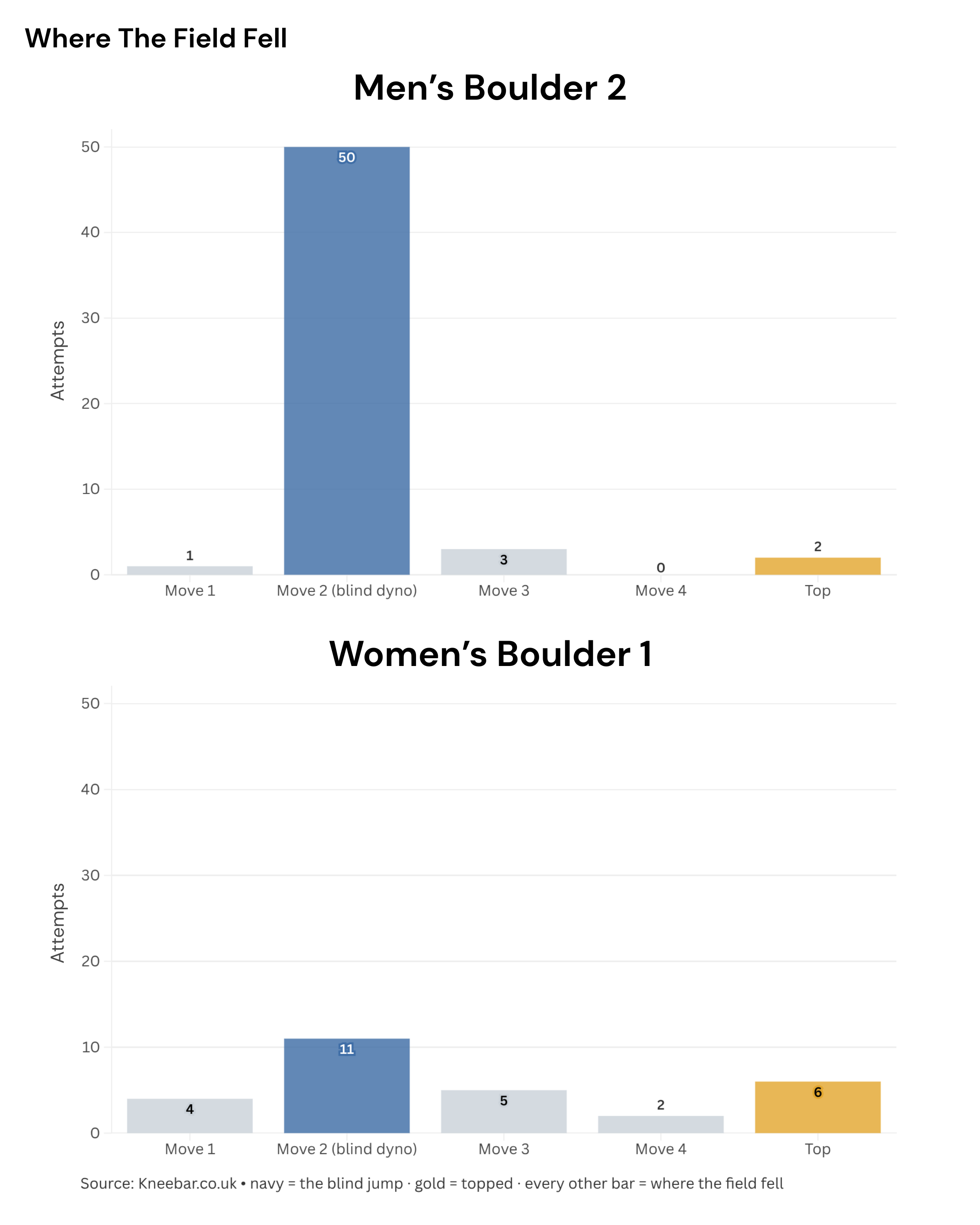
A blind dyno around an arête was the single most-failed move of the Madrid 2026 men’s final, ending 50 of 56 attempts on its boulder, Kneebar data shows, yet the same move sat on the most-topped boulder of the women’s round.
The read: The same move produced opposite rounds. On the men’s second boulder (M2) the jump ended 89% of the attempts; only three of eight climbers got past it to the zone, with two topping. On the women’s first boulder (W1), all eight passed it and six topped, more tops than any other boulder in the women’s final. The difference was not the movement. It was the hold waiting on the far side of the jump.
Routesetters: Tsukuru Hori (Head Routesetter), Anna Borella (Routesetter), Tsukasa Mizuguchi (Routesetter).*
The numbers:
The jump’s 50 falls were the most on any single move in the men’s final; the next, M4, had 39.
The three men who got through did so in four attempts or fewer, Anraku and Duffy on their third, Richard on his fourth.
The five men who never did made 41 attempts between them, with none reaching the zone.
On the women’s boulder the same dyno was still the most-failed move, but at 11 attempts, not 50 - and Oceana Mackenzie flashed it.
Six of the eight women topped; no other boulder in the final produced more than four tops.
The move: In both finals the climber launches around the corner of the arête toward the crowd, with no sightline to the hold on the other side. It is the kind of coordination move that produces a spectacular miss, athletes firing into open air and coming up empty, and in Madrid it produced dozens.
The calibration: The women caught a jug, on which they could stop before moving into the next section. The men caught a sloper, which wasn’t even the stopping point. They had to carry the momentum from around the corner straight through it and onto the next holds, a separate pair of slopers to hang from. Same jump, but a worse hold to catch, and a step inside the movement rather than a rest in it. The men’s boulder then hardened further: above the catch sat a downward move that held Samuel Richard at the zone, cost Sorato Anraku three attempts, and that only Colin Duffy passed clean. Swap the jug for a sloper you cannot pause on, then stack another hard move on top, and a gate becomes the move of the round.
What it means: The same launch was the most-failed move of one final and the most-solved boulder of the other. The movement never changed, only the hold at its end, and that small setting tune was the whole distance between a barrier and a gate.
*Official event documentation credits the team rather than individual boulders, so the jump is attributed here to the team, not to any one setter.